
| Quick Answer: Kids should brush for 2 minutes, twice a day, with fluoride toothpaste. Most children significantly underestimate two minutes — research shows kids typically brush for 30–45 seconds without a timer. Use a 2-minute song, an electric toothbrush with built-in timer, or a sand timer to make sure the full duration happens every time. |
If you’ve ever wondered how long your child should be brushing — or you’re skeptical that 2 minutes is really necessary — you’re not alone. Parents ask us this every week at Smiles for Kids Dentistry in Albuquerque. The honest answer: 2 minutes, twice a day, is the standard recommendation from the American Dental Association and the American Academy of Pediatric Dentistry — and it’s based on research, not arbitrary tradition.
Here’s why 2 minutes matters, what age-appropriate brushing routines look like, and how to actually make it happen at home.
How Long Should Kids Brush Their Teeth?
Two minutes. Twice a day. Every day. That’s the official guidance, and it applies to children from age 2 (when brushing starts in earnest) all the way through adolescence.
Why 2 minutes specifically:
- It takes that long to physically reach all surfaces of every tooth (outer, inner, chewing surface) for both upper and lower jaws
- Plaque is sticky — it requires mechanical disruption, not just contact, to remove
- Fluoride toothpaste needs contact time to strengthen enamel
- Research consistently shows brushing time correlates with plaque removal up to about the 2-minute mark
Less than 2 minutes leaves significant plaque behind. More than 2 minutes is fine but doesn’t add much benefit.
Why Kids Underestimate 2 Minutes
Studies of children’s brushing habits consistently find that kids brush for far less time than they think. Most children brush for 30–60 seconds when they’re not using a timer — even when they believe they brushed for 2 minutes.
This isn’t a kid problem; it’s a perception problem. Adults underestimate too. A 30-second brushing feels like it took longer than it did, especially when nobody’s measuring.
The fix: an external timer. Music, electric toothbrush, sand timer, app — anything that removes guesswork.
Age-by-Age Brushing Routines
| Age | Brushing Routine |
|---|---|
| 6 mo – 2 yr | Parent brushes with rice-grain smear of fluoride toothpaste, twice daily, for ~1 minute. |
| 2 – 6 yr | Child holds the brush; parent finishes the job. Pea-sized fluoride toothpaste. Full 2 minutes. |
| 6 – 8 yr | Child brushes with parent supervision. Spit-check still required. |
| 8+ yr | Independent brushing, with periodic parent checks for plaque/missed spots. |
The transition to independent brushing usually happens around age 8 — that’s roughly when most kids develop the manual dexterity to clean back teeth properly. Before that, parents should still be finishing the brushing.
How to Make 2 Minutes Happen
Six tactics that work, ranked by reliability:
1. The 2-minute song. Let your child pick a song that’s roughly 2 minutes. Brush for the full song, every morning and evening. Songs change over time — that’s fine. Music is the single most effective tool for getting kids to the full 2 minutes.
2. An electric toothbrush with a built-in timer. Most modern children’s electric brushes pulse or stop at 30 seconds, signaling a quadrant switch. Some have apps that gamify the experience. Worth the investment.
3. A 2-minute sand timer. Cheap, simple, no batteries. Kids love watching the sand. Visible on the bathroom counter.
4. A brushing app. Free apps like Brush DJ play music for 2 minutes; others (like Disney’s Magic Timer) reveal a hidden image as time passes. Best for the 4–8 age range.
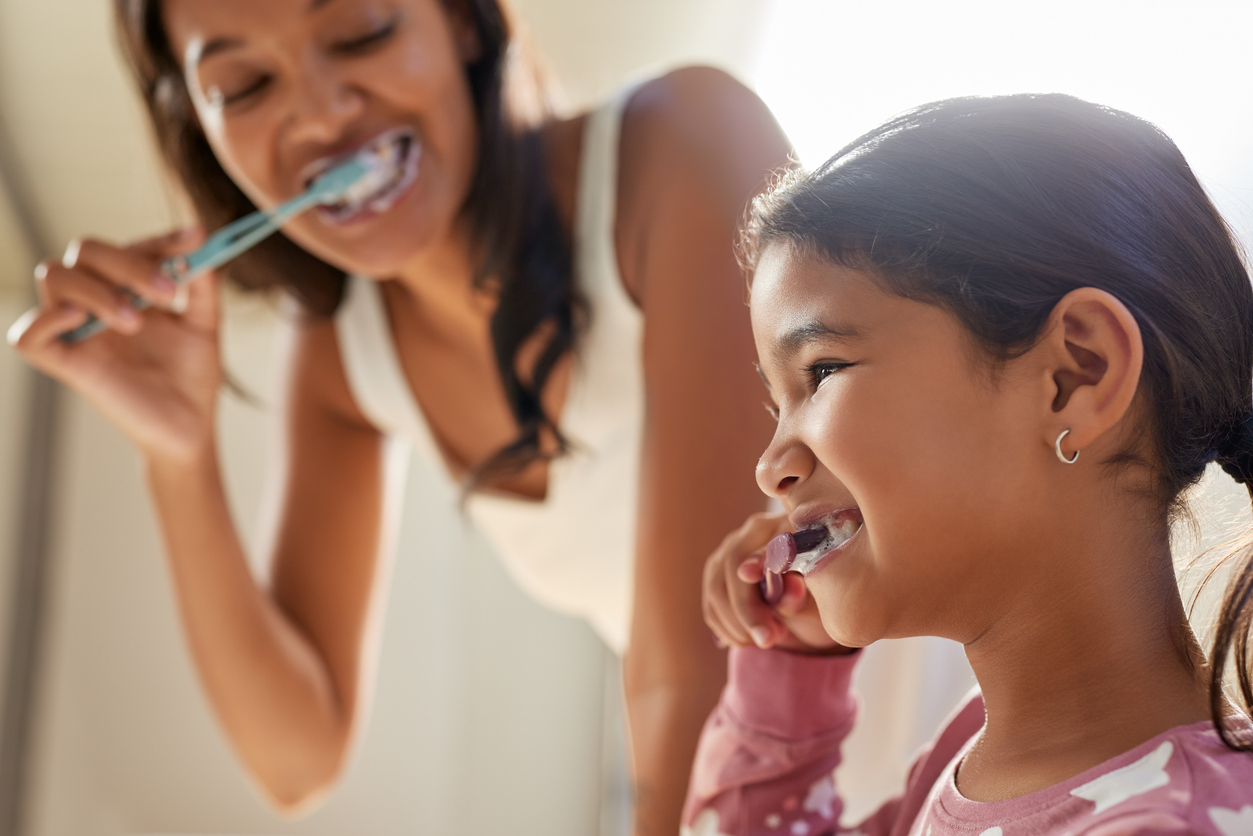
5. Brushing together. Brush alongside your child for the full 2 minutes. Modeling beats instruction. Plus you check off your own brushing.
6. The verbal countdown. “30 more seconds, top molars, let’s go!” Less reliable but works for kids who like external structure.
What 2 Minutes Should Cover
A full 2-minute brushing should cover:
- 30 seconds: outer surfaces, top teeth (front, sides, back)
- 30 seconds: outer surfaces, bottom teeth
- 30 seconds: inner surfaces, top + bottom
- 30 seconds: chewing surfaces, top + bottom + tongue
This is the standard “30 seconds per quadrant” approach taught in dental hygiene. For kids, you can simplify it to “front, sides, back” with reminders to get the inside.
What If My Child Won’t Brush for 2 Minutes?
You’re not alone. A few tips:
- Start where you are. If they’re brushing 45 seconds, get them to 60. Then 90. Then 2 minutes.
- Pair brushing with something they like (favorite song, a book they want to read aloud after).
- Avoid power struggles. The dentist is the bad guy at the next visit, not you.
- For very resistant kids, brush for them for the first minute, let them do the second.
- Ask their pediatric dentist to reinforce the message at the next visit. External authority helps.
Visit Smiles for Kids Dentistry
Our pediatric dental practice checks brushing technique at every visit and can give your child a hands-on demonstration if they need help. We see Albuquerque kids at both SFK East and SFK West, and we accept Medicaid and most private insurance.
Frequently Asked Questions
How long should kids brush their teeth?
Two minutes, twice a day, with fluoride toothpaste. This is the standard recommendation from the ADA and AAPD for children of all ages once brushing begins (around age 2).
Why is 2 minutes the right brushing time?
Two minutes is approximately how long it takes to physically reach all tooth surfaces (outer, inner, chewing) on both upper and lower jaws. Less time leaves significant plaque behind. Fluoride toothpaste also needs contact time to strengthen enamel.
How many times a day should kids brush?
Twice — morning and bedtime. Some pediatric dentists also recommend a midday rinse with water if your child snacks heavily during the day.
Are electric toothbrushes better for kids?
For most kids, yes. Built-in 2-minute timers solve the underestimation problem. Power-driven heads also remove plaque more effectively, especially for kids who don’t have great manual dexterity.
At what age can kids brush on their own?
Most kids develop enough manual dexterity around age 6–8 to brush effectively on their own — but parental supervision should continue until at least age 8. Before that, parents should still finish the brushing.
Should kids floss too?
Yes — as soon as any two teeth touch, usually around age 2–3. Use child-safe floss picks for younger kids. Most children need a parent’s help with flossing until age 8 or 9.
|
Time for your child’s checkup and brushing review? We truly care about your child’s health and happiness. Reach out to get your child’s appointment scheduled. We can’t wait to see you. Smiles for Kids Dentistry │ East: 2801 Eubank Blvd NE, Suite J (505) 299-9606 │ West: 9201 Eagle Ranch Rd NW (505) 892-9010 │ Find a Location → |