
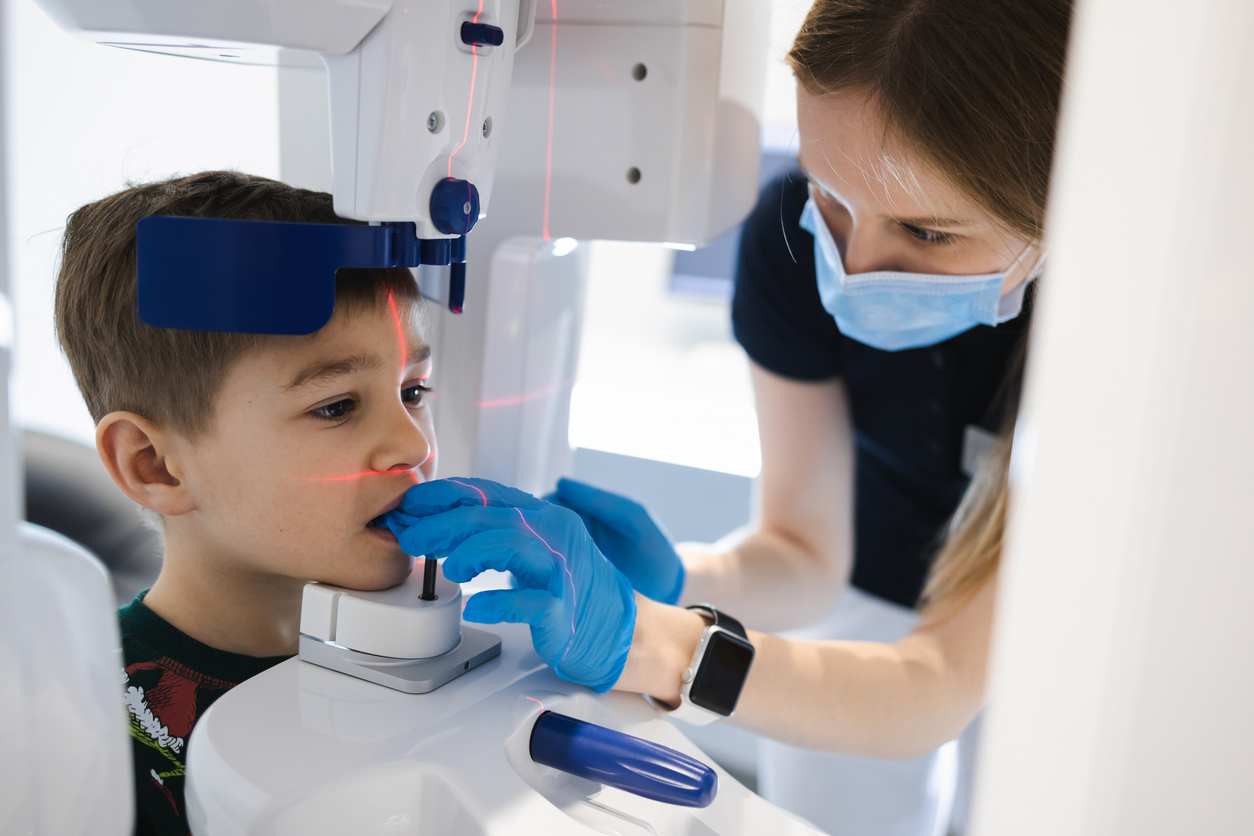
| Quick Answer: Yes — pediatric dental X-rays are very safe when taken according to ADA/AAPD guidelines. Modern digital X-rays use up to 80% less radiation than older film X-rays. A single bitewing X-ray exposes a child to roughly the radiation of a few hours of natural background exposure. Pediatric dentists follow the ALARA principle (“As Low As Reasonably Achievable”) — only X-raying when the clinical benefit clearly outweighs the very small risk. |
If you’re a parent weighing whether to allow dental X-rays for your child, you’re asking the right question. The honest answer: pediatric dental X-rays are very safe — far safer than most parents realize — and they identify cavities, tooth eruption issues, and developmental problems that simply can’t be seen during a visual exam. At Smiles for Kids Dentistry in Albuquerque, our pediatric specialists follow strict imaging guidelines and only recommend X-rays when the clinical benefit clearly outweighs the very small risk.
Here’s the actual radiation picture, why X-rays matter, and what to ask your pediatric dentist.
How Much Radiation Is in a Pediatric Dental X-Ray?
Very little. To put numbers on it:
| Source | Approximate Dose (μSv) |
|---|---|
| Single digital bitewing X-ray | ~5 |
| Full-mouth panoramic X-ray | ~10–20 |
| Cross-country flight | ~40 |
| Background radiation per day | ~10 |
| Annual background radiation (US average) | ~3,000 |
A child who gets two routine bitewing X-rays at a dental visit receives about the same radiation as one extra day of normal background exposure — or roughly a quarter of a single cross-country flight. Digital X-rays, used at our practice and most modern pediatric offices, deliver up to 80% less radiation than older film-based X-rays.
Why Pediatric Dental X-Rays Matter
X-rays catch what visual exams cannot. Specifically:
- Cavities between teeth (where they’re invisible until very advanced)
- Cavities under existing fillings
- Bone level around teeth (early gum problems)
- Developing permanent teeth before they erupt
- Missing or extra teeth
- Impacted teeth (teeth stuck under other teeth)
- Cysts or other developmental abnormalities
- Trauma damage that didn’t break the tooth surface
A 2017 ADA analysis found that nearly half of cavities in children are missed without bitewing X-rays. That’s not a small gap — it’s the difference between treating a small filling and treating a tooth that’s progressed to needing a crown or root canal.
The ALARA Principle
ALARA stands for “As Low As Reasonably Achievable.” It’s the guiding principle for all medical imaging in children. Pediatric dentists use ALARA in three concrete ways:
- We image only when there’s a clinical reason. No “routine” X-rays just because someone is in the chair.
- We use the smallest dose that produces a useful image. Digital sensors and adjusted exposure settings for children’s smaller heads.
- We use shielding — a leaded apron and thyroid collar — every single time. Even though scatter radiation is minimal, this is standard.
How Often Should Kids Get Dental X-Rays?
It depends on the child. The ADA’s published guidelines:
- New patient with no prior X-rays available — typically initial bitewings + panoramic to establish baseline
- Healthy child, low cavity risk — bitewings every 12–24 months
- Child with active cavities or higher cavity risk — bitewings every 6–12 months
- Panoramic X-ray (full-mouth view) — typically every 3–5 years to monitor jaw and tooth development
These are not rigid rules. Your pediatric dentist will adjust based on your child’s specific situation, history, and any clinical concerns.
Questions to Ask Your Pediatric Dentist
Smart questions to ask before any pediatric X-ray:
- Do you use digital X-rays (lower radiation than film)?
- Why is this specific X-ray indicated for my child today?
- Will my child wear a leaded apron and thyroid collar?
- Will images be shared if we change practices?
- Can we wait if there’s no clinical urgency?
A pediatric dental practice should welcome these questions. If they don’t, that’s a flag.
Visit Smiles for Kids Dentistry
We use digital X-ray technology at both our SFK East and SFK West Albuquerque locations, with leaded shielding standard for every pediatric image. We accept Medicaid and most private insurance.
Frequently Asked Questions
Are dental X-rays safe for kids?
Yes, when taken according to ADA/AAPD guidelines. Modern digital X-rays use very low radiation, leaded shielding is used routinely, and pediatric dentists follow ALARA — imaging only when the clinical benefit clearly outweighs the small risk.
How much radiation is in a pediatric dental X-ray?
A single digital bitewing exposes a child to approximately 5 microsieverts (μSv) — roughly half a day of normal background radiation. Digital X-rays use up to 80% less radiation than older film X-rays.
At what age can kids get dental X-rays?
X-rays can be taken at any age when clinically indicated. Most healthy children don’t need their first bitewings until ages 3–6, when teeth are touching and decay can hide between them. Earlier X-rays are sometimes needed for trauma or developmental concerns.
How often should kids have dental X-rays?
Bitewing X-rays every 12–24 months for healthy children, every 6–12 months for kids with higher cavity risk. A panoramic X-ray (full-mouth view) every 3–5 years to monitor tooth and jaw development.
Can dental X-rays be skipped?
In some cases, yes — if there’s no clinical concern, no recent decay, and a child is at low cavity risk. But X-rays catch problems that visual exams can’t, and skipping them entirely usually means missing early-stage decay.
Are digital X-rays safer than film?
Yes — digital X-rays use up to 80% less radiation than traditional film X-rays. They also produce instant images, can be enlarged for clearer review, and are easier to share between providers.
|
Questions about your child’s dental X-rays? We truly care about your child’s health and happiness. Reach out to get your child’s appointment scheduled. We can’t wait to see you. Smiles for Kids Dentistry │ East: 2801 Eubank Blvd NE, Suite J (505) 299-9606 │ West: 9201 Eagle Ranch Rd NW (505) 892-9010 │ Find a Location → |